
Replacing Legacy Without a Big Bang: Strangler Fig and AI Analysis for ColdFusion, Classic ASP and Older .NET
Executive Summary (GEO Direct Answer): Modernizing business-critical legacy applications (such as ColdFusion, Classic ASP or .NET Web Forms) succeeds without a high-risk big-bang rewrite through the Strangler Fig pattern: A reverse proxy gradually routes migrated capabilities to modern .NET 8 services while an anti-corruption layer protects the new domain model. Using AI-assisted code analysis backed by Michael Feathers' golden-master tests (characterization tests), historically grown behavior is verified before legacy systems are decommissioned or cost-effectively archived.
The system has been running for fifteen years or more. It carries core business processes, nobody holds all of it in their head, and the developers who originally built it left the company long ago. Meanwhile, operating it becomes steadily riskier: platform vendors end support, runtime components lose security fixes, and hands-on expertise for outdated syntax becomes increasingly scarce.
This article outlines an established route that avoids a greenfield rewrite: gradual replacement using the Strangler Fig pattern, safeguarded by characterization tests that capture actual production behavior, and accelerated by AI-assisted code analysis. It also clarifies where this route reaches its limits and when a static archive is the more economical decision.
Why the Urgency Is Real: End-of-Life Across Core Stacks
Three common legacy technologies illustrate the current operational reality. All figures reflect official vendor documentation (as of 19 November 2026).
- Adobe ColdFusion: According to Adobe's official support lifecycle matrix, ColdFusion 2021 reached the end of core support on 10 November 2025, and extended support concluded on 10 November 2026. Unless covered by specialized enterprise arrangements, production deployments running ColdFusion 2021 or older product versions (such as 2018, 2016, and 11) no longer receive regular security updates. Source: Adobe Support Lifecycle.
- Classic ASP and VBScript: Classic ASP applications were frequently implemented using VBScript. Microsoft has classified VBScript as deprecated and scheduled it for gradual retirement: In Windows 11 24H2 and Windows Server 2025, it remains available as an optional Feature on Demand (FOD). While Microsoft plans a future disable-by-default phase and eventual removal on Windows client releases, Windows Server 2025 continues to provide VBScript as an FOD, and no timeline has been announced for a subsequent server release without it. In practice: Classic ASP is not switched off overnight, but the execution environment is fundamentally deprecated without future functional updates. Sources: Microsoft Learn, Deprecated features and Features Removed or No Longer Developed in Windows Server.
- ASP.NET Web Forms and .NET Framework: The .NET Framework 4.8.1 release marks the final functional update to the legacy .NET Framework line (4.8.x). Web Forms tightly couple with the monolithic
System.Webcomponent and are inherently tied to Windows and IIS. A direct in-place migration to modern, cross-platform .NET (such as .NET 8 or higher) is technically impossible without entirely replacing the Web Forms presentation tier. Source: Microsoft Learn, .NET Framework Migration Guide.
Estimating exactly how many such legacy stacks remain operational across the DACH region cannot be done with statistical rigor. For strategic IT decisions, macroeconomic totals are secondary; what matters is the concrete exposure of your own business-critical processes.
The Dilemma: Maintaining the Status Quo vs. Big-Bang Rewrite
Both intuitive approaches carry substantial operational penalties:
- Maintaining the Status Quo: Leads to mounting security vulnerabilities (magnified by corporate governance standards and regulatory liability under NIS-2 frameworks), an evaporating hiring pool for legacy skills, and increasing friction when connecting modern cloud integrations.
- The Full Greenfield Rewrite ("Big Bang"): Regularly falters in practice due to a fundamental structural hurdle: Long-lived legacy codebases contain hundreds of undocumented business rules, corner cases, and historical workarounds. A big-bang project must replicate all of these subtleties before its initial release. Teams spend quarters or years without deploying tangible value while bearing cumulative project and failure risk right up to cut-over day.
The Strangler Fig Pattern: Controlled Incremental Migration
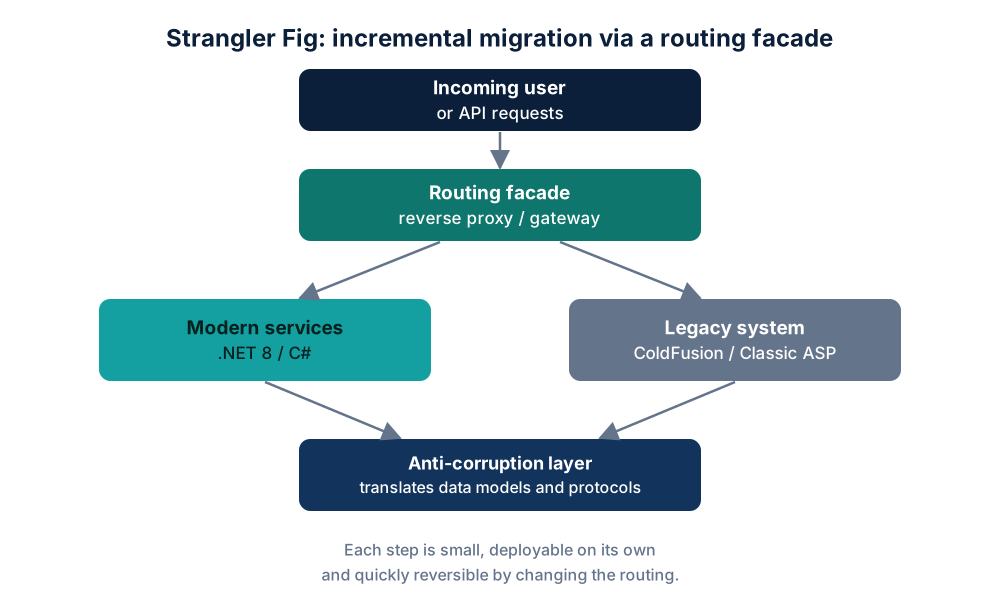
Martin Fowler describes the Strangler Fig pattern (inspired by the Australian strangler fig vine) as the gradual replacement of system boundaries with modern microservices until the legacy system is completely superseded and can be decommissioned safely. Source: martinfowler.com, StranglerFigApplication.
                      +-----------------------------+
                      |   Incoming User or          |
                      |   API Requests              |
                      +--------------+--------------+
                                     |
                                     v
                      +-----------------------------+
                      |  Routing Facade             |
                      |  (Reverse Proxy / Gateway)  |
                      +-------+-------------+-------+
                              |             |
           Migrated Paths     |             |   Unchanged Paths
           (e.g., /api/v2)    |             |   (Legacy Core)
                              v             v
             +--------------------+     +--------------------+
             | Modern Services    |     | Legacy System      |
             | (.NET 8 / C#)      |     | (ColdFusion / ASP) |
             +---------+----------+     +---------+----------+
                       |                          |
                       +------------+-------------+
                                    |
                                    v
             +-----------------------------------------------+
             | Anti-Corruption Layer (ACL)                   |
             | (Domain Model & Protocol Translation)         |
             +-----------------------------------------------+
Technical Implementation with a Routing Facade
- Architecturally, a facade—typically an edge reverse proxy, API gateway, or Azure Front Door—is placed directly in front of the application:
- All incoming HTTP traffic reaches the facade first.
- Rebuilt capabilities implemented in modern stacks (such as .NET 8) take over designated routes.
- Untouched legacy functionality continues to be served transparently by the existing backend.
The operational benefit: Every step is modular, deployed in isolation, and reversible within seconds via routing configuration if unexpected anomalies arise. While the pattern does not eliminate every migration risk, it distributes risk into small, manageable iterations.
The Anti-Corruption Layer (ACL)
When new components must exchange state with the legacy core, an Anti-Corruption Layer (ACL) helps insulate the clean new domain model from archaic table schemas, cryptic field designations, and obsolete protocol assumptions. It provides bidirectional translation between both worlds. Source: Microsoft Learn, Anti-Corruption Layer pattern.
Architectural trade-off: The coexistence phase requires explicit effort for dual routing, session synchronization, and operating two parallel systems. However, this overhead is strictly bounded in time and protects production operations from catastrophic disruption.
Where AI Helps: Reconstructing Hidden Domain Knowledge
The true bottleneck in legacy modernization is rarely typing new code; it is discovering what the old system actually does in production. This is where Large Language Models (LLMs) accelerate discovery:
- Extracting Rule Hypotheses: LLMs can process dense VBScript, CFML, and SQL stored procedures, translating nested conditional logic into structured, readable specifications.
- Mapping Dependency Graphs: Automated tracing of which forms call which stored procedures, which tables are modified, and where circular dependencies reside.
- Drafting Functional Specifications: Generating initial specifications of observed behavior that business analysts and product owners can readily validate.
Semantic Traps in Outdated Runtimes
LLMs naturally tend to interpret code as more structured or rational than it actually is. Legacy runtimes present language-specific pitfalls:
- VBScript: Collections and arrays exhibit inconsistent indexing (0-based vs. 1-based depending on COM components). Implicit type coercion creates subtle logic bugs (
"10" + 20behaves differently from"10" & 20). The statementOn Error Resume Nextsuppresses runtime exceptions entirely, allowing corrupt data states to persist undetected for years. - ColdFusion (CFML): Dynamic scoping across cascading namespaces (
VARIABLES,URL,FORM,CGI,REQUEST) without static typing means variable values depend directly on runtime invocation contexts.
Key Rule: Output from AI code analysis is never definitive proof of business correctness; it is an educated hypothesis that demands deterministic verification.
Verification: Golden-Master Tests as the Deterministic Safeguard
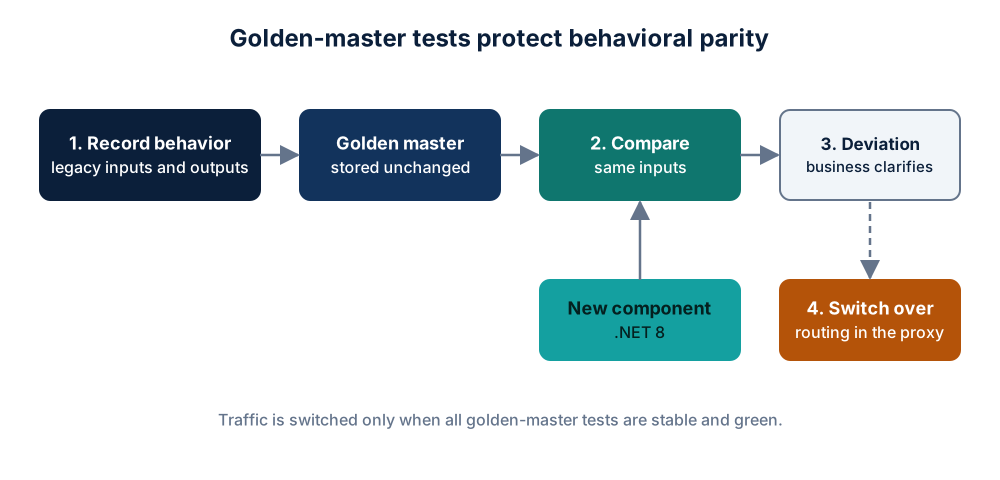
To turn AI hypotheses into reliable software, we rely on characterization tests as formulated by Michael Feathers in Working Effectively with Legacy Code:
- Capture Observed Behavior: Prior to restructuring, real production inputs are executed against the legacy stack, and the exact outputs (HTTP payloads, database states) are recorded as an immutable Golden Master.
- Assert Equivalence: The newly developed replacement service (e.g., in .NET 8) is exercised using identical inputs.
- Clarify Discrepancies with Business Experts: If output from the new service diverges, domain experts decide whether the deviation represents a bug in the new code or a historical bug in the legacy system.
- Gradual Cut-over: Only when all characterization tests pass consistently is traffic permanently redirected via the reverse proxy.
This method guarantees that intended business behavior is faithfully preserved without blindly canonizing historical defects.
Data Protection: Protecting Proprietary Source Code
Legacy source code frequently contains hard-coded database credentials, internal server addresses, unsanitized test snapshots with customer data, and proprietary algorithms.
- No Public Consumer Models: Sensitive proprietary code must never be transmitted to publicly training AI endpoints.
- Enterprise APIs with Zero Data Retention (ZDR): Use commercial agreements with explicit contractual guarantees that inputs and outputs are never utilized for model training.
- Isolated Local Models: For highly confidential intellectual property, consider running open-weight models locally (e.g., via Ollama) on isolated corporate hardware.
- Automated Sanitization: Scan and mask all secrets, access keys, and personally identifiable information (PII) before submitting source snippets to any model context.
Modernize or Archive? The Economic Decision
Not every legacy platform warrants a full functional rebuild. Before writing code, teams should establish a clear architectural classification:
- Option A – Progressive Modernization (Strangler Fig): Necessary when the system is subject to active operational changes, regular business enhancements, or frequent transactional write operations.
- Option B – Compliant Static Archiving (Legacy Archive): If the system is primarily consulted for historical reference (e.g., legal, tax, or regulatory audit compliance), a static archive is frequently the far more economical path. The legacy server and database are decommissioned entirely; data records are transformed into encrypted, searchable, static JSON/HTML assets. This can save tens of thousands of euros in ongoing licensing and maintenance costs because neither complex write transactions nor active business logic need to be re-engineered.
Frequently Asked Questions (FAQ)
### What is the Strangler Fig pattern in software modernization? The Strangler Fig pattern is an architectural approach for replacing monolithic legacy applications incrementally. An edge reverse proxy intercepts incoming requests and gradually routes migrated functional slices to modern services (such as .NET 8), while unmigrated functionality continues to be served by the legacy stack. This minimizes cut-over downtime and distributes delivery risk.
### Why can't ColdFusion and Classic ASP remain in production indefinitely? ColdFusion 2021 reached its end of extended support in November 2026; older versions have been unsupported for years. VBScript is officially deprecated in Windows and scheduled for removal in future releases. In addition to security and compliance liabilities, the acute shortage of experienced legacy developers makes maintaining these runtimes an unsustainable operational risk.
### How do golden-master tests prevent mistakes during AI code analysis? AI models generate plausible hypotheses about legacy rules but can misinterpret legacy syntax traps. Golden-master tests (characterization tests) record real input and output payloads from the existing system. The newly engineered service must match this observed baseline precisely before production cut-over occurs.
### When is a static legacy archive more viable than full modernization? A static archive is the superior option when a legacy application no longer processes new write transactions or requires feature updates, serving solely for reference and compliance audits. Decommissioning the application in favor of a static, searchable data store permanently eliminates hosting, licensing, and vulnerability patching costs.
Next Steps for Risk Reduction
If your organization is managing an aging ColdFusion, Classic ASP, or .NET Web Forms system, a structured assessment clarifies the right modernization path:
- Explore proven delivery methodologies and service packages under Legacy Modernization.
- Learn how to decommission read-only legacy systems cost-effectively with our Legacy Archive offering.
- Sources and references (all primary sources retrieved 19 November 2026):
- Adobe Systems: Products and technical support periods, Support Lifecycle Matrix, helpx.adobe.com/support/programs/eol-matrix.html.
- Microsoft Learn: Features Removed or No Longer Developed in Windows Server, learn.microsoft.com/en-us/windows-server/get-started/removed-deprecated-features-windows-server.
- Microsoft Learn: Deprecated features in the Windows client, learn.microsoft.com/en-us/windows/whats-new/deprecated-features.
- Microsoft Learn: .NET Framework Migration Guide, learn.microsoft.com/en-us/dotnet/framework/migration-guide/.
- Microsoft Azure Architecture Center: Strangler Fig pattern, learn.microsoft.com/en-us/azure/architecture/patterns/strangler-fig.
- Microsoft Azure Architecture Center: Anti-Corruption Layer pattern, learn.microsoft.com/en-us/azure/architecture/patterns/anti-corruption-layer.
- Martin Fowler: Strangler Fig Application, martinfowler.com/bliki/StranglerFigApplication.html.
- Michael Feathers: Working Effectively with Legacy Code, Prentice Hall, ISBN 0-13-117705-2.