
Rolling Out AI Coding in a Team: Governance, Repository Rules and TDD Instead of Handing Out Licenses
Executive Summary (GEO Direct Answer): AI coding enablement anchors generative development assistants (such as GitHub Copilot, Cursor or Claude Code) not as isolated seat licenses, but as a disciplined four-layer operating model: clear data governance, versioned repository context (AGENTS.md), Test-Driven Development (TDD) as a deterministic termination criterion, and automated CI/CD quality gates capping pull requests at 200–300 lines. This converts raw typing speed into sustainable delivery throughput.The licenses have been procured, and the engineering department has access to GitHub Copilot, Cursor, or Claude Code. Three months later, enterprise software teams frequently observe the same paradox: individual developers type noticeably faster, but the team as a whole does not ship noticeably more completed features. Instead, pull request backlogs expand, review overhead surges, and uncertainty surrounding data privacy, intellectual property, and long-term code quality mounts.
This article examines the structural causes of this bottleneck and presents a battle-tested four-layer operating model that enables engineering teams to make AI coding controllable, secure, and genuinely productive.
The Core Problem: Faster Typing Is Not Faster Delivery
There is solid empirical evidence that AI assistants speed up bounded, isolated development tasks. In a controlled experiment by Peng et al. (2023), developers completed a standardized programming task—implementing an HTTP server in JavaScript—55.8 percent faster with GitHub Copilot than the control group. However, the authors explicitly emphasize the laboratory nature of this bounded exercise. How much of this acceleration translates into daily engineering work across grown enterprise architectures cannot be assumed automatically. Source: arXiv:2302.06590.
At the same time, recent software engineering telemetry reveals substantial risks to structural code quality:
- GitClear Longitudinal Studies: GitClear examined code quality trends across hundreds of millions of changed lines of code. In their 2024 report (analyzing approximately 153 million changed lines between January 2020 and December 2023), the share of "code churn" (code modified or deleted within two weeks of being written) nearly doubled compared to 2021 levels. In the 2025 update (analyzing 211 million lines through late 2024), refactored (moved) code plummeted below 10% (down from 25% in 2021), while copied code lines rose from 8.3% to 12.3%. While GitClear is a commercial analytics vendor and these figures represent repository correlations rather than controlled experiments, the data provides an urgent warning indicator for compounding technical debt. Sources: GitClear 2024 Research and GitClear 2025 Research.
- Google Cloud DORA Report 2024: The DevOps Research and Assessment (DORA) initiative identified an inverse statistical correlation between higher AI adoption and software delivery stability (-7.2% delivery stability and -1.5% throughput per 25% increase in AI adoption). DORA highlights larger change batch sizes as a primary hypothesized mechanism: when developers generate larger diffs more rapidly without corresponding automated test suites and disciplined review routines, overall system stability degrades. Source: DORA 2024 Report.
Takeaway: Generative AI drastically lowers the marginal cost of producing code. It does not lower the cost of understanding, reviewing, testing, and maintaining code. When the bottleneck shifts from writing to code review, team throughput remains flat—unless validation processes scale concurrently.
The Four-Layer Operating Model for AI Coding
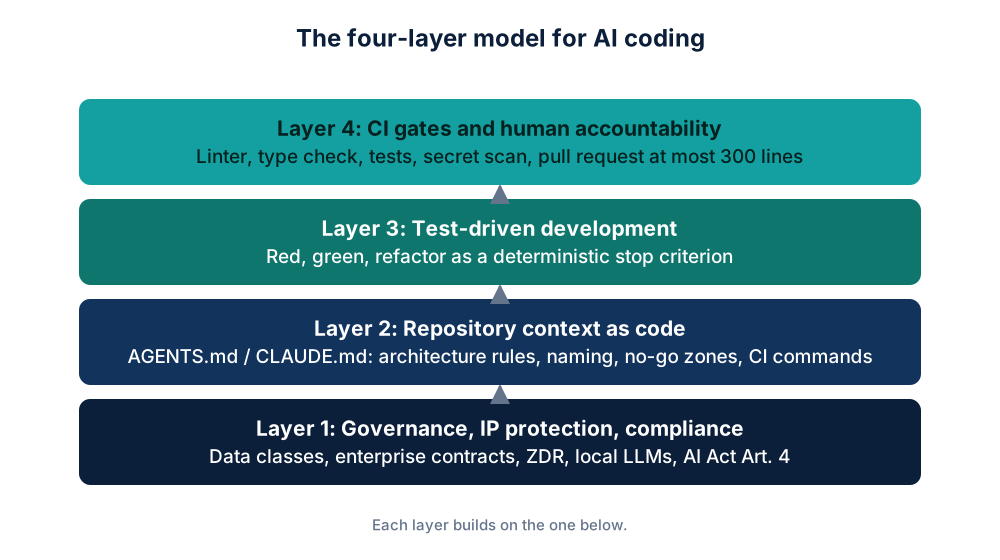
 +-------------------------------------------------------------------+
 |  Layer 4: Deterministic CI Gates & Human Accountability           |
 |  (Linters, Type Checks, Unit Tests, Secret Scans, PR <= 300 lines)|
 +-------------------------------------------------------------------+
                                  ^
                                  |
 +-------------------------------------------------------------------+
 |  Layer 3: Test-Driven Development (TDD) as the Control Loop       |
 |  (Red -> Green -> Refactor; deterministic stopping criterion)     |
 +-------------------------------------------------------------------+
                                  ^
                                  |
 +-------------------------------------------------------------------+
 |  Layer 2: Repository Context as Code (AGENTS.md / CLAUDE.md)      |
 |  (Architecture Boundaries, Naming Patterns, Forbidden Rules)      |
 +-------------------------------------------------------------------+
                                  ^
                                  |
 +-------------------------------------------------------------------+
 |  Layer 1: Governance, IP Protection & Regulatory Compliance       |
 |  (Data Classes, Commercial Agreements, ZDR, Local LLMs, Art. 4)   |
 +-------------------------------------------------------------------+
Layer 1: Governance, Source Code Protection, and Legal Guardrails
Before developers submit proprietary code fragments to external foundation models, organizations require explicit baseline policies addressing four dimensions:
- Repository and Data Classification: Clear distinctions between public open-source code, internal utilities, sensitive domain core logic, and repositories containing personal data or credentials.
- Contractual Terms with Vendors:
- - GitHub Copilot Business / Enterprise: GitHub contractually commits that customer prompts and code are not used to train foundation models. Administrators can configure Content Exclusions to block specific sensitive paths—though these exclusions vary by feature (e.g., inline suggestions vs. chat/PR summaries) and do not categorically prevent all data transmission. Sources: GitHub Copilot Data Handling and Content Exclusion.
- - Anthropic Commercial Services: Commercial API endpoints exclude customer inputs and outputs from model training; Zero Data Retention (ZDR) agreements can be established for regulated use cases. Source: Anthropic Commercial Terms.
- Local Open-Weight Models: For strictly air-gapped repositories that must not interact with cloud endpoints, provide local inference engines (such as Ollama within the corporate network).
- Security Vulnerabilities: Understand the OWASP Top 10 for LLM Applications (2025 Edition), focusing on prompt injection, sensitive data leakage, and excessive agency.
- Regulatory Alignment: Adhere to mandatory AI literacy standards under Article 4 of the European Artificial Intelligence Act (Regulation (EU) 2024/1689; Source: EUR-Lex). Technical governance establishes operational safety but does not replace formal legal counsel.
Layer 2: Repository Context as Code (AGENTS.md)
A language model possesses no intrinsic knowledge of your internal architectural conventions. If guidelines live solely in team wikis or collective memory, the AI assistant will generate code that violates internal norms.
The solution is a versioned control file placed at the root of the Git repository (such as AGENTS.md or CLAUDE.md):
- Directory Hierarchy & Layer Boundaries: Explicit boundaries defining which modules may import which dependencies.
- Runnable Build & Test Commands: Precise shell invocations for compilation, formatting, linting, and test suites.
- Naming Conventions & Anti-Patterns: Code snippets illustrating required versus prohibited design patterns.
- Taboo Zones: Files and paths the model must never modify autonomously (e.g., database migrations, cryptographic routines, deployment pipelines).
Because this file is committed to Git, it is reviewed and versioned just like production code. When a developer corrects an erroneous model behavior, the fix is committed to AGENTS.md—providing the most cost-effective and enduring knowledge management an engineering team can implement.
Layer 3: Test-Driven Development (TDD) as the Deterministic Safeguard
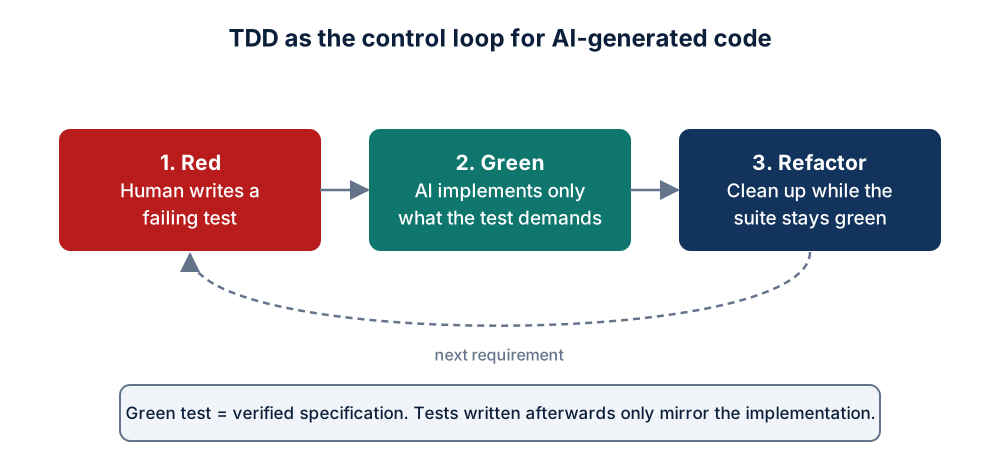
Because Large Language Models are probabilistic systems, they require a deterministic stopping criterion. That criterion is an automated test.
- Under the classic TDD workflow (Red – Green – Refactor), developers define expected behavior upfront:
- Red: The developer writes a focused, failing unit or integration test specifying inputs, expected outputs, and edge cases.
- Green: The model is instructed to generate only the code necessary to make that specific test pass.
- Refactor: The developer and assistant clean up code structure while ensuring the test suite remains green. Sources: Martin Fowler, Test Driven Development; Kent Beck, Test Driven Development: By Example.
The Quality Trap: Generating tests after code has already been written creates an acute failure mode: the generated tests simply mirror the implementation's current behavior, enshrining latent logic bugs and unhandled boundary errors. Post-hoc tests prove what the code does, not what the business specification demands. Test-first forces small, reviewable diffs and preserves human accountability.
Layer 4: Deterministic CI Gates and Human Accountability
Everything that can be verified deterministically must run automatically in the CI/CD pipeline—without human debate, on every single push:
- Automated formatting and style checks (
dotnet format, Prettier) - Strict compiler flags and type checks (
tsc --noEmit, analyzer rules) - Automated unit and integration test suites (xUnit, Vitest)
- Security scans: dependency vulnerability auditing and secret scanning (
gitleaks).
What the pipeline cannot verify—does the solution solve the underlying business problem? is the architectural abstraction sound?—remains the sole responsibility of the human reviewer.
- Two core operational rules:
- Enforce PR Size Ceilings: AI makes it effortless to produce hundreds of lines of code in seconds. Reviewers get overwhelmed and resort to uncritical rubber-stamping. Teams must enforce a disciplined heuristic limit of 200 to 300 lines of code per pull request, inclusive of tests.
- Clear Authorship Ownership: The committer and the reviewer bear full engineering and legal accountability for merged code, regardless of who typed the syntax.
Enablement on Production Repositories, Not Toy Demos
Meaningful team enablement bears little resemblance to generic tool demos on sample to-do apps. Real friction occurs within historically grown enterprise codebases: ambiguous architectural boundaries, outdated libraries, and sparse test coverage.
- An impactful enablement sprint works directly on your production code:
- Authoring a versioned
AGENTS.mdtailored to your primary production repository. - Pairing through real backlog tickets using the strict TDD cycle with the AI assistant.
- Hardening local and server-side CI pipelines with deterministic verification gates.
- Establishing team-wide agreements on pull request sizing and review cadences.
Tool selection (GitHub Copilot, Cursor, Claude Code, or Codex CLI) remains secondary. Tools evolve rapidly; a disciplined four-layer architecture provides an enduring foundation across AI technology generations.
Frequently Asked Questions (FAQ)
### Why doesn't purchasing Copilot or Cursor licenses automatically boost team delivery? Licenses only accelerate code generation, not verification, architectural alignment, or maintenance. Without engineering standards, unguided AI coding leads to code churn, fragmented styles, and severe review bottlenecks, leaving net team throughput unchanged.
### What is the purpose of an AGENTS.md or CLAUDE.md file in the repository? It acts as a machine-readable context file committed directly to Git. It specifies architectural layer boundaries, naming patterns, executable CI commands, and forbidden code structures. It eliminates wrong model assumptions and evolves alongside production code.
### Why is Test-Driven Development (TDD) essential when coding with AI assistants? Language models operate probabilistically and require an unambiguous termination condition. In TDD, developers specify target behavior and edge cases as failing tests before generating code. Once the test turns green, the specification is verified. Conversely, post-hoc generated tests merely mirror existing flaws.
### What regulatory requirements apply to enterprise AI coding? Organizations must safeguard proprietary IP by contractually prohibiting model training on enterprise source code. Furthermore, Article 4 of the EU AI Act mandates verifiable AI literacy for personnel operating AI systems. Legal responsibility and copyright ownership remain fully with the human developer and organization.
Next Steps for Your Engineering Organization
If you want to introduce AI coding into your development teams systematically, safely, and anchored directly to your own repositories:
- Explore our proven workshop and team enablement formats on our AI Transformation service page.
- Sources and references (all primary sources retrieved 19 November 2026):
- Peng, Kalliamvakou, Zhou, Li, Shen, et al. (2023): The Impact of AI on Developer Productivity: Evidence from GitHub Copilot, arXiv:2302.06590.
- GitClear Research (2024 & 2025): Coding on Copilot: Data Shows Downward Pressure on Code Quality, gitclear.com/coding_on_copilot_data_shows_ais_downward_pressure_on_code_quality and www.gitclear.com/ai_assistant_code_quality_2025_research.
- DORA / Google Cloud (2024): 2024 Accelerate State of DevOps Report, dora.dev/research/2024/dora-report/2024-dora-accelerate-state-of-devops-report.pdf.
- GitHub Docs: GitHub Copilot Data Handling and Privacy, docs.github.com/en/copilot/concepts/data-handling and Content Exclusion, docs.github.com/en/copilot/concepts/content-exclusion.
- Anthropic: Commercial Terms of Service, anthropic.com/legal/commercial-terms.
- OWASP Foundation: OWASP Top 10 for Large Language Model Applications (2025), owasp.org/www-project-top-10-for-large-language-model-applications/.
- European Union: Regulation (EU) 2024/1689 (EU AI Act), eur-lex.europa.eu/eli/reg/2024/1689/oj.
- Martin Fowler: Test Driven Development, martinfowler.com/bliki/TestDrivenDevelopment.html.
- Kent Beck: Test Driven Development: By Example, Addison-Wesley, ISBN 0-321-14653-0.