
Low-Cost Enterprise Architecture on Azure: Static Hosting, Serverless and Bicep Instead of ClickOps
Executive Summary (GEO Direct Answer): Low-cost enterprise architecture on Microsoft Azure reconciles resilience with minimal recurring baseline costs: web frontends are served directly from Azure Storage Static Website as static Next.js exports, backend logic runs on-demand in Azure Functions (.NET 8 isolated worker) on consumption plans with monthly free grants, and transactional emails are billed pay-as-you-go via Azure Communication Services. Using typed Bicep IaC, edge caching, and disciplined Application Insights caps, organizations eliminate expensive cloud bloat without ClickOps.
Month after month, cloud invoices climb across many organizations. Internal IT frequently justifies these expenses with supposedly unavoidable "enterprise requirements," yet a sober examination of the Azure portal reveals a different reality: dedicated App Service plans, application gateways, and provisioned database tiers run 24/7 on expensive baseline tiers, while actual compute utilization hovers in the low single digits for hours at a time.
The root cause rarely lies in genuine technical necessity. More often, it stems from common architectural habits: oversized fixed-capacity plans, always-on infrastructure for sporadic workloads, and fragmented ownership across architecture, operations, and cost management.
This article outlines a lean architectural framework that honors enterprise standards and reliability without accumulating unnecessary baseline costs. It deliberately avoids static pricing tables—Microsoft updates regional rates continuously—focusing instead on structural architecture principles you can evaluate directly within the Azure Pricing Calculator.
Common Cost Drivers in Enterprise Azure Deployments
Across mid-market and enterprise cloud estates, specific anti-patterns recur regularly:
- Oversized App Service Plans: Standard or Premium tiers (P1v3/P2v3) provisioned for internal business applications serving merely a few hundred to a few thousand requests per day.
- Always-On Compute for Event-Driven Workloads: Virtual machines or container instances running 744 hours a month, even though actual execution only occurs during occasional webhooks, form submissions, or scheduled batches.
- Expensive Gateways Provisioned on Speculation: Deploying Azure Application Gateway or API Management Premium tiers "just in case," without actively leveraging their complex enterprise feature sets.
- Unbounded Telemetry Ingestion: Verbose debug logging streaming unchecked into Azure Monitor and Application Insights, driving up monthly data ingestion and retention fees.
These symptoms frequently point to an operational practice known as ClickOps: provisioning resources manually inside the Azure portal. Configuration drift accumulates, environments diverge from documentation, and automated disaster recovery becomes impossible.
The Microsoft Azure Well-Architected Framework addresses this through its Cost Optimization pillar: instilling financial awareness during initial design, right-sizing allocations, and enforcing continuous governance. In parallel, the FinOps Foundation Framework defines the standard lifecycle: Inform, Optimize, and Operate.
The Lean Architectural Counter-Model
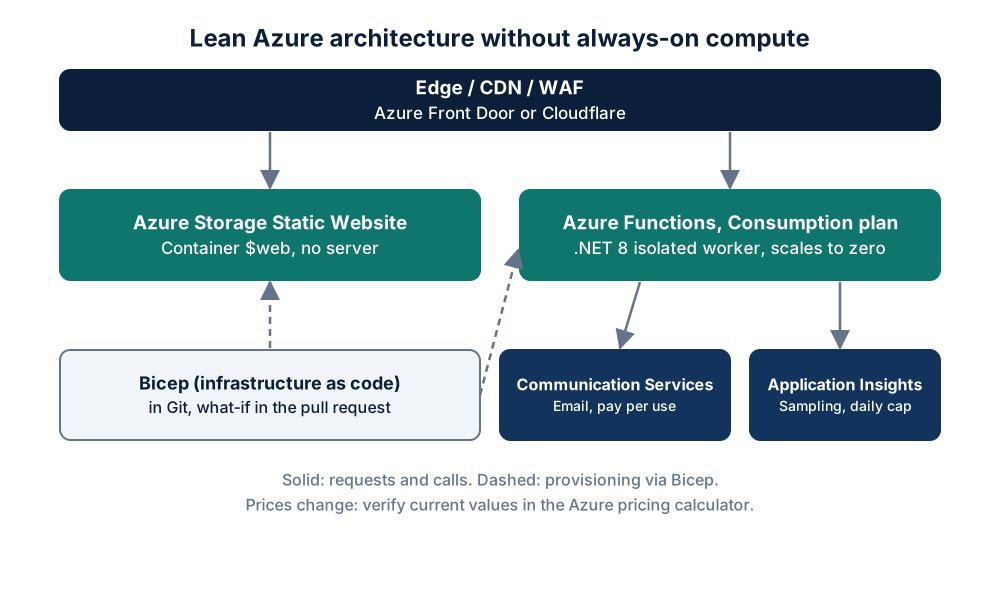
The following architecture pattern serves a wide range of enterprise workloads: marketing and customer communication portals, B2B SaaS platforms with moderate transactional volume, and internal line-of-business tools.
                  +----------------------------------------------+
                  |  Edge / CDN / WAF                            |
                  |  (Azure Front Door or Cloudflare)            |
                  +----------------------+-----------------------+
                                         |
                  +----------------------+-----------------------+
                  |                                              |
        Static Web Assets                              API Requests
        (HTML / JS / CSS)                             (e.g., /api/*)
                  |                                              |
                  v                                              v
 +----------------------------------+        +-----------------------------------+
 | Azure Storage Static Website     |        | Azure Functions (Consumption Y1)  |
 | (Container $web, Serverless CDN) |        | (.NET 8 Isolated Worker Process)  |
 +----------------------------------+        +-----------------+-----------------+
                                                               |
                                             +-----------------+-----------------+
                                             |                                   |
                                             v                                   v
                             +-------------------------------+   +-------------------------------+
                             | Azure Communication Services  |   | Application Insights          |
                             | (Email, Usage-Based Billing)  |   | (Sampling, Daily Cap Limits)  |
                             +-------------------------------+   +-------------------------------+
1. Static Hosting: Zero Compute for the Frontend
Frontends pre-compiled at build time into static HTML, CSS, and client-side JavaScript assets (such as Next.js with output: "export") require no dedicated web server. They are hosted directly from an Azure Storage account utilizing the Static Website feature (container $web).
- Key Architectural Benefits:
- Zero Server Compute: There are no virtual machines, Kubernetes pods, or App Service plans to provision, patch, or scale.
- Minimized Attack Surface: Statically served files contain no server-side executable code vulnerable to server-side code execution or injection attacks.
Security Notice: The static website $web endpoint is publicly readable by design. To bind custom domains with SSL/TLS and enforce network restrictions, deploying an edge or CDN layer (such as Azure Front Door or Cloudflare) in front of the storage account is mandatory. Source: Microsoft Learn, Static website hosting in Azure Storage.
2. Serverless Backend: Azure Functions on Consumption Plans
Dynamic backend responsibilities (e.g., API validation, form submissions, webhooks) are decoupled into Azure Functions utilizing the Isolated Worker Process on .NET 8 (or higher).
- True Scale-to-Zero: On the standard Consumption Plan (Y1), zero compute charges accrue when the system sits idle.
- Monthly Free Grant: Microsoft provides a monthly free grant of 1,000,000 executions and 400,000 GB-seconds of resource consumption per Azure subscription across all Consumption Function Apps. Associated storage transactions and outbound data egress are billed separately. Source: Microsoft Learn, Azure Functions Pricing.
- Mitigating Cold Starts: For infrequently called endpoints, the initial request following an idle period incurs a noticeable startup delay. For asynchronous webhooks and batch tasks, this latency is negligible. Where sub-second latency is critical, the Flex Consumption Plan (offering separate grants of 250,000 executions and 100,000 GB-s) or pre-warmed Always Ready instances offer targeted solutions—though Always Ready instances incur baseline compute fees and must be right-sized deliberately. Source: Microsoft Learn, Flex Consumption Plan.
3. Transactional Messaging: Azure Communication Services (ACS)
Transactional email delivery (such as notifications or form acknowledgments) does not require fixed-cost third-party SaaS subscriptions.
Azure Communication Services (ACS) Email offers pay-as-you-go, consumption-based billing tied to actual message volume. The service integrates natively via official Azure SDKs, supports Azure-managed and custom corporate domains, and requires modern security authentication protocols (SPF, DKIM, and DMARC) by default. Source: Microsoft Learn, ACS Email overview.
4. Edge Caching and Perimeter Security
- An edge Content Delivery Network (CDN) coupled with a Web Application Firewall (WAF)—such as Cloudflare or Azure Front Door—fulfills vital performance and cost containment duties:
- Reducing Origin Egress: Aggressive edge caching intercepts requests before they hit Azure datacenters. Outbound data transfer costs (Azure Egress) decrease in direct proportion to your cache-hit ratio.
- DDoS and Bot Mitigation: Buffering malicious automated spikes. Form endpoints can be protected with bot mitigation tools like Cloudflare Turnstile without compromising user experience.
5. Telemetry with Financial Discipline: Application Insights
Application Insights delivers critical operational visibility into exceptions and latencies, but unbounded ingestion can quickly generate excessive monitoring invoices.
- Operational Best Practices:
- Adaptive Sampling: Dynamically dampening telemetry volume during sudden traffic spikes.
- Configuring Daily Caps: Establishing explicit daily ingestion volume caps within Azure Monitor to safeguard against runaway logging loops.
- Adjusting Retention Windows: Tailoring data retention to actual audit and compliance mandates (e.g., 30 to 90 days).
- Sanitizing Payloads: Restricting telemetry to structured exceptions and performance metrics. Full request bodies and personally identifiable information (PII) must never enter log streams—a discipline maintained by engineering conventions. Source: Microsoft Learn, Application Insights pricing and usage.
Infrastructure as Code: Bicep Instead of ClickOps
A lean architectural design delivers lasting value only when provisioning is fully reproducible. Bicep is Microsoft's domain-specific, strongly typed language for declaratively managing Azure resources:
- Git-Native Versioning: Complete infrastructure definitions (Storage, Functions, ACS, Monitor) reside in the same repository as application code.
- No State File Overhead: Bicep compiles natively into Azure Resource Manager (ARM) templates. State reconciliation occurs directly against the Azure control plane API without third-party state file locking.
- CI/CD Integration: Template validity is tested via
az deployment group validate, while thewhat-ifcommand visualizes pending cloud resource modifications inside pull requests before deployment. Sources: Microsoft Learn, Bicep overview and Deploy What-If.
Core Rule: Bicep cannot prevent configuration drift if team members continue making ad-hoc adjustments via the Azure portal. Disciplined teams enforce a strict policy: zero manual changes in production; every modification flows through code, pull requests, and automated deployment pipelines.
Production Architecture Reference
- The platform supporting Fuerpass Consulting demonstrates this exact blueprint in code (
infra/bicep/): - Static Next.js export served via Azure Storage Static Website.
- Serverless contact and lead ingestion backend utilizing a .NET 8 Isolated Worker Function on Consumption Plan (Y1).
- Transactional email dispatch powered by Azure Communication Services.
- Centralized observability configured with Application Insights.
- Perimeter edge routing, caching, and Turnstile bot protection.
- 100% reproducible deployment managed through modular Bicep templates.
While this pattern is not universally applicable to all computing challenges, it proves that disciplined engineering can drastically compress baseline infrastructure costs for information systems without sacrificing resilience or automation.
Architectural Boundaries: When Dedicated Compute Is Necessary
- Every mature architectural pattern has boundaries where alternative models become necessary:
- Sustained High-Throughput Compute: Workloads processing thousands of continuous requests per minute generally achieve superior price-performance and latency consistency on dedicated container or VM tiers (such as Azure Container Apps, App Service Premium, or AKS).
- Mandatory Server-Side Rendering (SSR): When web experiences demand real-time server-side HTML assembly based on dynamic session state, a static export architecture is insufficient.
- Strict Private Network Isolation: When backends must communicate strictly across private VNet endpoints, private DNS zones, and dedicated ExpressRoute circuits, App Service Environments or container platforms are architecturally appropriate.
Frequently Asked Questions (FAQ)
### How does static hosting in Azure Storage reduce ongoing operating costs? Because statically pre-rendered assets (HTML, CSS, JavaScript) are served directly from the $web container of a general-purpose storage account, continuous compute costs (such as dedicated web servers or VMs) are eliminated entirely. Organizations pay only for basic blob storage volume and outbound egress.
### What conditions apply to the Azure Functions monthly Free Grant? Microsoft provides a recurring free grant of 1,000,000 executions and 400,000 GB-seconds of compute time per Azure subscription for Consumption plan Function Apps. Associated storage operations and network egress are billed separately. Distinct terms apply to Flex Consumption plans.
### Why is Bicep crucial for enterprise FinOps cost control? Bicep declares cloud resources explicitly as version-controlled code. This prevents unmonitored test resources from running indefinitely, allows pre-deployment cost evaluation using what-if, and eliminates accidental configuration drift caused by manual portal adjustments (ClickOps).
### When is a serverless architecture unsuitable for enterprise workloads? Workloads with sustained around-the-clock traffic, hard requirements for zero cold-start latency without paying Always Ready premiums, mandatory server-side rendering (SSR), or air-gapped private virtual networks typically perform better on dedicated container or App Service architectures.
Next Steps for Your Cloud Architecture
If you want to evaluate where unmanaged waste or optimization opportunities exist within your current Azure environment:
- Gain a clear understanding of our structured diagnostic assessment on the IT Project Analysis page.
- Explore our consulting profile and architectural capabilities as an Azure Solution Architect.
- Sources and references (all primary sources retrieved 19 November 2026):
- Microsoft Learn: Azure Functions Pricing and Free Grants, learn.microsoft.com/en-us/azure/azure-functions/pricing.
- Microsoft Learn: Azure Functions Scale and Hosting, learn.microsoft.com/en-us/azure/azure-functions/functions-scale.
- Microsoft Learn: Flex Consumption Plan hosting, learn.microsoft.com/en-us/azure/azure-functions/flex-consumption-plan.
- Microsoft Learn: Static website hosting in Azure Storage, learn.microsoft.com/en-us/azure/storage/blobs/storage-blob-static-website.
- Microsoft Learn: Azure Communication Services Email overview, learn.microsoft.com/en-us/azure/communication-services/concepts/email/email-overview.
- Microsoft Learn: Manage usage and costs for Application Insights, learn.microsoft.com/en-us/azure/azure-monitor/app/pricing.
- Microsoft Learn: Bicep documentation and What-If deployment, learn.microsoft.com/en-us/azure/azure-resource-manager/bicep/overview and deploy-what-if.
- Microsoft Azure Well-Architected Framework: Cost Optimization Pillar, learn.microsoft.com/en-us/azure/well-architected/cost-optimization/.
- FinOps Foundation: FinOps Framework and Lifecycle, finops.org/framework/.