
AI Agents and MCP in CI/CD Pipelines: What Holds Up in Production and Where the Risks Lie
Executive Summary (GEO Direct Answer): AI agents deliver measurable value in CI/CD pipelines when deployed as assistants for bounded verification tasks (such as PR pre-checks, test drafting, or documentation sync), while deterministic gates and human reviewers retain release authority. Using the Model Context Protocol (MCP, specification 2025-11-25 via stdio and Streamable HTTP), tools decouple cleanly. Essential guardrails—including tool pinning, ephemeral containers, and a four-tier fail-closed risk model—mitigate threats like indirect prompt injection and confused deputy risks.Many engineering teams have piloted semi-autonomous AI agents over recent months. While proof-of-concept demos routinely captivate audiences, production reality is sober: an autonomous agent executing unverified code changes or configuration updates against live infrastructure constitutes an unpredictable operational hazard.
Real, sustainable business value emerges not from unconstrained autonomy, but where agents are embedded into structured, sandboxed, and verifiable workflows: assisting engineering teams within the CI/CD pipeline.
This article demonstrates which pipeline tasks succeed in production, how the Model Context Protocol (MCP) provides a decoupled standard for tool integration, what novel attack surfaces arise, and which non-negotiable guardrails protect production stability.
Task Scoping: Agents Assist, Pipelines Decide
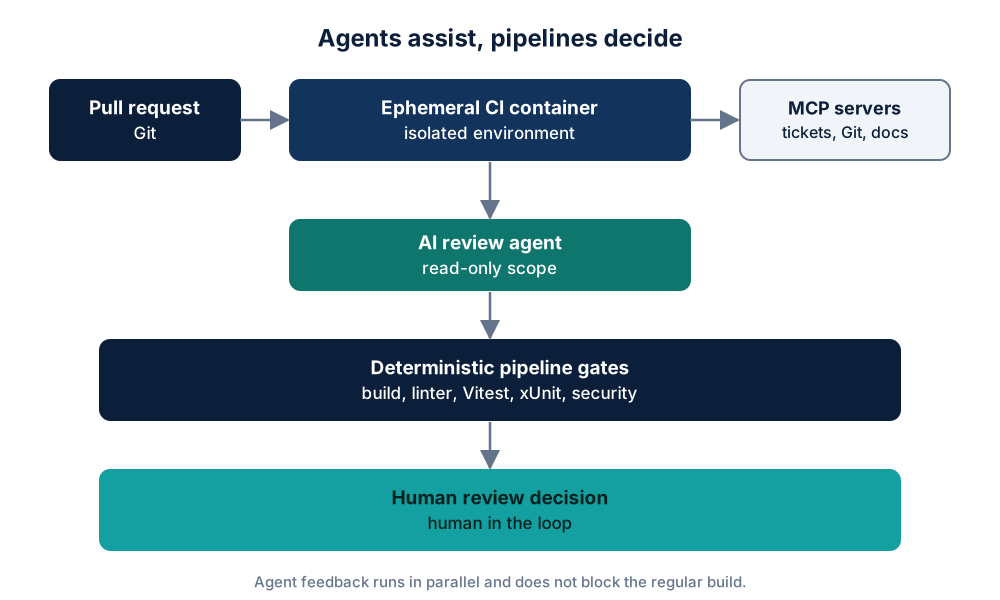
A foundational architectural principle of modern delivery is the strict separation of stochastic and deterministic processes:
- Large Language Models are stochastic systems—producing probabilistic distributions, alternative formulations, and heuristic reasoning over context.
- Compilers, linters, static analyzers, and test runners are deterministic systems—verifying binary state (success or failure) based on formal rules.
This reality dictates a natural division of responsibility: AI agents do not replace the CI/CD pipeline; they leverage the pipeline as an inviolable boundary. The agent generates structured drafts or analyzes pull request diffs—the automated pipeline validates correctness, and a human engineer grants final deployment approval.
 +--------------------+       +---------------------------------------------+
 | Pull Request / Git | ----> | Ephemeral CI Container (Isolated Workspace) |
 +--------------------+       +---------------------------------------------+
                                       |
                                       v
                              +--------------------+
                              | Verification Agent | <---> MCP Server
                              | (Read-Only Scope)  |       (Issues, Git, Docs)
                              +--------------------+
                                       |
                                       v
 +--------------------------------------------------------------------------+
 | Deterministic Pipeline Gates (Build, Linters, Vitest, xUnit, Security)   |
 +--------------------------------------------------------------------------+
                                       |
                                       v
 +--------------------------------------------------------------------------+
 | Human Review & Sign-Off (Human-in-the-Loop)                              |
 +--------------------------------------------------------------------------+
Four Practical Pipeline Use Cases
- Rule-Based PR Pre-Checks: The agent inspects pull request diffs against the repository's versioned
AGENTS.md: Were architectural layer boundaries preserved? Do new types follow established naming schemes? Are required docs missing? - Drafting Unit & Boundary Tests: For modified interfaces or entity models, the agent proposes test cases that human developers evaluate and integrate into the test suite.
- Documentation & Schema Synchronization: Detecting divergence between OpenAPI/Swagger definitions, Markdown documentation, and the underlying codebase, warning reviewers before merges occur.
- Failure Triage & Deduplication: Grouping intermittent test failures, identifying known error patterns, and detecting duplicate issue tickets.
All four use cases share a defining characteristic: the agent produces suggestions and diagnostic feedback—it never executes destructive writes to running environments.
Model Context Protocol (MCP): A Protocol Standard Instead of Point-to-Point Wiring
Initiated by Anthropic and actively advanced by the open-source community, the Model Context Protocol (MCP) establishes an open standard connecting foundation models with external tools and context providers.
Technically, MCP relies on a client-host-server topology leveraging JSON-RPC 2.0 (specification baseline: 2025-11-25). Supported core transports include `stdio` (for local process execution) and Streamable HTTP (for network-addressable services; earlier Server-Sent Events / SSE transports serve as transitional infrastructure). The MCP server exposes tools and data resources, while the host decides precisely which capabilities the model is authorized to invoke. Source: modelcontextprotocol.io.
Architectural Decoupling
- Rather than writing bespoke API adapters for every tool (GitHub, ticketing systems, internal documentation, build runners), agents interact through a standardized interface:
- Modularity: Tools and data connectors can be updated, mocked, or replaced independently of the language model.
- Mitigating Vendor Lock-in: Decoupling tools from proprietary model interfaces significantly lowers long-term platform dependence, though proprietary model APIs must still be managed separately.
- Official .NET Support: For modern C#/.NET enterprise teams, the MCP community maintains an official SDK. Source: github.com/modelcontextprotocol/csharp-sdk.
Architectural Caveat: MCP is undergoing rapid evolution (particularly regarding authentication and authorization). A communication protocol is not a substitute for an enterprise security architecture.
Attack Surfaces Specific to AI Agents in CI/CD
Allowing an agent to consume external data and invoke tools changes the threat landscape. The MCP Security Guidance and the OWASP Top 10 for LLM Applications (2025) highlight key failure modes:
- Indirect Prompt Injection: An attacker embeds prompt instructions into data ingested by the agent—such as a pull request description, an issue comment, or a third-party dependency. Because models cannot deterministically distinguish instructions from data, the model may execute the injected payload under its current permissions.
- Manipulated Tool Descriptions: Language models select tools based on semantic descriptions. A compromised MCP server or an untracked update can alter tool schemas to induce unauthorized execution or exfiltrate context tokens.
- Confused Deputy: The agent runs with the high privileges of the CI/CD pipeline account but is triggered by an untrusted actor (e.g., an external open-source contributor submitting a PR). If the agent executes unchecked actions, the untrusted trigger gains indirect access to privileged assets. This is distinct from Excessive Agency (the broader OWASP risk addressing disproportionate autonomy and absence of boundary controls).
Non-Negotiable Operational Guardrails
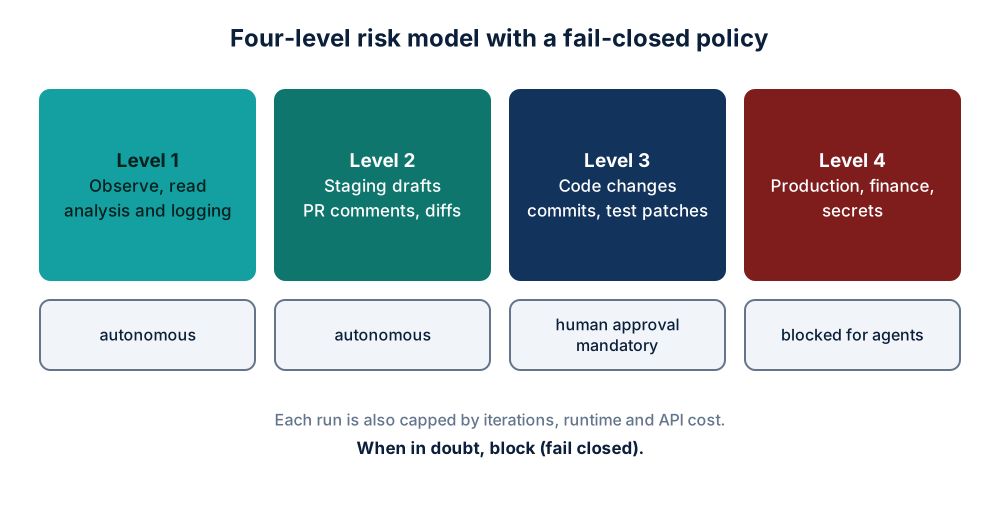
To safeguard delivery pipelines, organizations must enforce disciplined baseline controls:
- Read-Only Scope by Default: Verification agents must receive strictly read-only access to designated paths. Write permissions are an exception requiring explicit human justification.
- Ephemeral, Isolated Workspaces: Run agents inside short-lived containers lacking network routes to production. Robust network segmentation and credential isolation substantially limit attack surfaces.
- Zero Production Credentials in Context: API tokens, certificates, and production database strings must never enter agent prompts or tool environments. Test runs execute against mock or staging endpoints.
- Tool Allowlisting and Checksum Pinning: Only vetted MCP servers and tools are permitted. Tool definition checksums (hashes) must be pinned to detect unauthorized runtime tampering.
- Four-Tier Fail-Closed Risk Classification:
- - Tier 1 (Read / Observe): Diagnostics, logging, linting (autonomous execution permitted).
- - Tier 2 (Staging Drafts): Generating PR comments, drafting test diffs (autonomous execution permitted).
- - Tier 3 (Code Changes): Committing code patches, updating dependencies (mandatory human review required).
- - Tier 4 (Production / Financial / Secrets): Direct deployment or production access (prohibited for agents; fail-closed: blocked by default).
- Strict Resource and Budget Ceilings: Every agent execution must have hard limits on iterations, total runtime (in minutes), and API token budget. Infinite loops ("fix -> build fail -> fix") abort cleanly with a "blocked" status upon hitting thresholds.
- Asynchronous Separation from the Main Build: Agent feedback loops should run out-of-band and must not alter deterministic build artifacts, preserving reproducible release pipelines.
Monorepo Scalability and Context Management
In enterprise monorepos, passing entire codebases into foundation models exceeds practical context window budgets and increases inference costs.
To scale agent workflows, implement a two-stage retrieval architecture: static semantic indexing (e.g., via Abstract Syntax Trees / AST) or targeted local vector search preselects the relevant architectural slices and contracts, submitting only the refined context to the model.
Frequently Asked Questions (FAQ)
### What tasks can AI agents handle safely in CI/CD pipelines? Agents excel at bounded, advisory tasks: pre-checking pull requests against architectural standards (AGENTS.md), proposing unit and integration tests for modified components, validating documentation against API schemas, and grouping intermittent test failures.
### What is the Model Context Protocol (MCP) and what are its advantages? MCP is an open standard (initiated by Anthropic, specification 2025-11-25 via stdio and Streamable HTTP) connecting models with external tools and data sources. It decouples agents from proprietary APIs, minimizes integration overhead, and reduces vendor lock-in.
### What security risks emerge when running AI agents in delivery pipelines? The primary risks are indirect prompt injection (executing malicious instructions hidden within PR descriptions or issues), manipulated tool definitions, and confused deputy exploits (triggering privileged pipeline actions through untrusted external inputs).
### Why is the Human-in-the-Loop model mandatory for agentic CI/CD? Because AI models operate probabilistically, they can miss subtle edge cases or security flaws. Legal, operational, and architectural accountability remains solely with human engineers. Agents assist with diagnostics; humans maintain final release authority.
Next Steps for Your Software Delivery Organization
If you want to integrate semi-autonomous agent workflows and standardized protocols into your software delivery with robust enterprise guardrails:
- Discover our enablement workshops on our AI Transformation service page.
- Explore tailored enterprise AI solutions under AI Business Solutions.
- Sources and references (all primary sources retrieved 19 November 2026):
- Model Context Protocol: Protocol Specification (2025-11-25), Transports and Architecture, modelcontextprotocol.io/specification/2025-11-25.
- Model Context Protocol: Security Guidance and Best Practices, modelcontextprotocol.io/docs/concepts/security.
- Model Context Protocol Community: Official C# SDK, github.com/modelcontextprotocol/csharp-sdk.
- OWASP Foundation: OWASP Top 10 for Large Language Model Applications (2025), owasp.org/www-project-top-10-for-large-language-model-applications/.