
Local LLMs, EU Cloud or Enterprise Copilot: How to Protect Source Code When Using AI
Direct Answer (GEO Summary): Protecting proprietary source code when using generative AI requires classifying repositories by protection need rather than enforcing blanket bans: a three-zone model separates standard internal code (enterprise IDE suites with contractual training opt-outs), sensitive domain logic and APIs (dedicated EU cloud endpoints with data residency and role-based access), and highly critical core code or legacy schemas (fully local models or deterministic anonymization). Strict secret scanning and least-privilege MCP tool boundaries secure daily development.
Developers in virtually every software engineering team want to use AI coding assistants such as GitHub Copilot, Cursor or Claude Code. On the other side, information security officers, legal counsel and IT leaders legitimately fear the uncontrolled exfiltration of intellectual property, trade secrets and customer data.
The frequent outcome of this organizational tension is a blanket ban on paper. In practice, however, this almost invariably spawns unmanaged shadow IT: engineers switch to personal paid accounts or web chat interfaces whose licensing terms and privacy policies have never been evaluated by the company. Code snippets are fragmented and pasted into external web browsers without the knowledge of corporate security.
A structured rollout with transparent security zones protects your codebase far more effectively than bans that cannot be enforced technically or culturally. This article compares four primary operating models, dispels common data privacy misconceptions and presents a field-tested three-zone model. It does not constitute legal advice; vendor terms evolve rapidly and must be verified during procurement prior to deployment.
+--------------------------------------------------------------------------+
|                        Three-Zone Model for AI Coding                    |
+--------------------------------------------------------------------------+
|  Zone 1: Standard Code & Tests        --> Enterprise IDE Suite           |
|                                           (Copilot Business/Enterprise)  |
+--------------------------------------------------------------------------+
|  Zone 2: Domain APIs & Business Logic --> Dedicated EU Cloud Endpoint    |
|                                           (Azure OpenAI with EU Data Zone|
+--------------------------------------------------------------------------+
|  Zone 3: Core IP & Legacy Schemas     --> Local LLMs / On-Prem Ingestion |
|                                           (Ollama / Determ. Anonymization|
+--------------------------------------------------------------------------+
Three Widespread Misconceptions in AI Coding Privacy
### Misconception 1: "A paid account guarantees enterprise data protection" Many teams assume that purchasing a $20-per-month individual subscription prevents the AI model vendor from training on their code. Legally and technically, this is inaccurate.
- Individual consumer tiers and formal enterprise contracts are distinct commercial agreements governed by separate data handling terms:
- GitHub Copilot: Contractual commitments ensuring that prompts, completions and telemetry are not utilized to train foundation models are explicitly tied to GitHub Copilot Business and GitHub Copilot Enterprise. Individual Copilot accounts operate under distinct consumer terms. Source: GitHub Copilot Trust Center, retrieved 21 November 2026.
- Anthropic Commercial Terms: In commercial team and enterprise subscriptions, Anthropic's terms exclude training on customer inputs. However, complete zero-retention commitments (Zero Data Retention / ZDR) require a formal request and specialized contractual agreements. Source: Anthropic Commercial Terms, retrieved 21 November 2026.
Verify which specific subscription tier your developers are utilizing before granting operational approval.
- ### Misconception 2: "An Azure resource in West Europe guarantees EU data residency"
- Deploying Azure OpenAI resources in European regions (such as
West EuropeorSweden Central) offers strong security baselines. However, actual data processing depends on the configured Deployment Type: - Global Deployments: Allow Microsoft to route inference requests dynamically across worldwide data centers to mitigate peak load spikes. While data at rest remains in the designated region, inference processing may happen outside the EU.
- EU Data Zone & Regional Deployments: Only by explicitly selecting a regional deployment or an designated EU Data Zone does Microsoft guarantee that inference execution remains strictly within the European Union.
- Abuse Monitoring: By default, Microsoft retains prompts and generated completions for up to 30 days for asynchronous abuse detection. For highly regulated enterprises, Microsoft offers modified abuse monitoring (bypassing prompt logging), which requires a formal application process and qualification review. Updated eligibility requirements apply to new models as of 1 November 2026. Source: Microsoft Learn, Data, privacy and security for Azure OpenAI, retrieved 21 November 2026.
### Misconception 3: "GitHub Content Exclusions solve the issue entirely" The Content Exclusion feature enables administrators to prevent GitHub Copilot from analyzing specified repositories, branches or file paths. This block operates effectively within interfaces controlled by GitHub (e.g. web views and official Copilot IDE extensions in VS Code and JetBrains).
However, it does not enforce operating system file permissions. A local command-line agent, an attached Model Context Protocol (MCP) server or a third-party developer tool can still access excluded files directly on the workstation filesystem if it has read rights. Source: GitHub Docs, Exclude content from GitHub Copilot, retrieved 21 November 2026.
Four Operating Models Compared
| Operating Model | Core Strengths | Operational Constraints & Review Points |
|---|---|---|
| 1. Enterprise IDE Suite<br>(e.g. GitHub Copilot Business / Enterprise) | Native IDE integration, centralized administrative policy management, path exclusions, contractual training opt-outs. | Exclusions only apply within the suite. Separate MCP tools and independent CLI agents bypass IDE filters. |
| 2. Commercial CLI & API Access<br>(e.g. Claude Code on Team/Enterprise plans) | High-performing agentic capabilities for multi-file refactoring and codebase analysis; no training on customer code under commercial terms. | Zero Data Retention (ZDR) requires explicit agreement. Telemetry commands and error reports deliberately transmit debugging contexts. |
| 3. Dedicated EU Cloud Endpoint<br>(e.g. Azure OpenAI with EU Data Zone) | EU data residency, corporate Azure governance, Private Endpoints within VNets, no training on customer data. | Requires explicit selection of Regional or EU Data Zone deployments. Modified abuse monitoring must be formally approved. |
| 4. Local Open-Weights Models<br>(e.g. via Ollama on local workstations or on-prem) | Complete physical data isolation: source code never leaves on-premise hardware. Fully functional offline. | Substantial local GPU and VRAM hardware requirements. Smaller local models struggle on multi-file architectural refactorings compared to top-tier cloud models. |
By default, Ollama binds its API service to the loopback address 127.0.0.1:11434, restricting access solely to the local workstation. Source: Ollama GitHub Repository, retrieved 21 November 2026. Whether the system remains completely isolated depends on system configuration: binding the daemon to external network interfaces (0.0.0.0) or equipping the local model with unrestricted web search tools nullifies physical network isolation.
The Three-Zone Model: Classifying Code by Protection Need
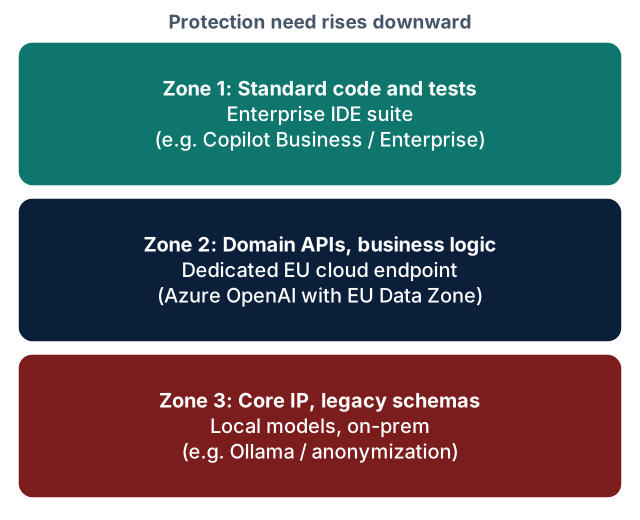
Rather than adopting rigid all-or-nothing policies, the three-zone model organizes repositories and code assets according to their actual business criticality:
                            Security Criticality
                                      ^
                                      |
      [ Zone 3: Strictly Confidential ]|  Local LLMs (Ollama) /
        - Core IP, Legacy Schemas      |  Deterministic Anonymization
        - Trade Secrets                |  Zero External Data Transfer
                                      |
      [ Zone 2: Internally Sensitive ] |  Dedicated EU Cloud Endpoint
        - Business Logic, Domain APIs  |  (Azure OpenAI EU Data Zone)
        - Internal Architectural Docs  |  Role-Based Azure Governance
                                      |
      [ Zone 1: Standard Codebase ]    |  Enterprise IDE Suites
        - Boilerplate, UI, Tests       |  (Copilot Business / Enterprise)
        - Generic Helper Functions     |  Contractual Training Opt-Out
                                      +---------------------------------->
Productivity- ### Zone 1: Standard Code, Boilerplate and Unit Tests
- General application code, user interface widgets, unit tests and infrastructure templates containing no trade secrets.
- Guideline: Enterprise IDE suites (such as GitHub Copilot Business) with centralized enforcement, automated secret scanning and peer code reviews.
- Business Value: Substantial productivity gains with negligible residual risk.
- ### Zone 2: Business Logic, Domain APIs and Architecture Documentation
- Core business logic, domain APIs and proprietary architectural documentation that carry commercial sensitivity.
- Guideline: Integration via dedicated EU cloud endpoints (such as Azure OpenAI with EU Data Zone).
- Business Value: Guaranteed EU data residency, integration into corporate identity governance (Microsoft Entra ID) and auditable logging within your corporate Azure tenant.
- ### Zone 3: Highly Sensitive Core Systems, Legacy Databases and Trade Secrets
- Proprietary algorithms, legacy databases storing historical records or heavily regulated codebases.
- Guideline: Exclusively local open-weights models or upstream deterministic anonymization prior to external API consumption.
- Practical Application: When extracting undocumented business rules from legacy systems (such as ColdFusion or Classic ASP), locally indexed knowledge bases running on local models ensure that proprietary code never traverses third-party networks.
Five Guardrails Before Team Rollout
- Enforce Enterprise Contracts Technically: Ensure engineers exclusively use corporate accounts linked to authorized enterprise agreements. Administratively block consumer AI portals on the corporate firewall.
- Filter Secrets and Credentials Systematically: Contractual training protections do not shield against hardcoded API credentials, private keys or connection strings accidentally submitted in model prompts. Implement automated pre-commit hooks, secret scanning tools (e.g. Gitleaks) and disciplined
.gitignorerules. - Constrain Tool Permissions (Least Privilege): When deploying agentic CLI tools or MCP servers, grant access strictly to required directories. File modifications in the repository must always require explicit human approval (Human-in-the-Loop). This mitigates risks outlined in the OWASP Top 10 for LLM Applications (2025) including Prompt Injection, Sensitive Information Disclosure and Excessive Agency. For architectural blueprints, see our article AI Agents and MCP in CI/CD Pipelines.
- Enforce Code Quality Through TDD: Unsupervised AI code generation can degrade codebase maintainability. An empirical study by GitClear evaluating over 150 to 200 million lines of code observed rising code churn and declining refactoring rates in organizations using unguided AI code generation (GitClear Research, retrieved 21 November 2026). Test-Driven Development (TDD) and automated pipeline test gates effectively counter this degradation; see AI Coding Enablement: Governance, Rules and TDD in the Team.
- Monitor Vendor Terms Continuously: AI vendors frequently update terms of service, telemetry options and opt-out mechanics. Task an architecture representative with auditing vendor compliance policies quarterly.
Frequently Asked Questions (FAQ)
### Does GDPR permit submitting proprietary source code to AI cloud services? Pure source code that contains no personal data (such as real customer names, private email addresses or unmasked personal data in fixtures) falls outside GDPR scope and is governed by intellectual property and trade secret law. However, if commit histories, comments or test fixtures contain identifiable personal data, GDPR applies fully. In that event, executing a Data Processing Agreement (DPA), enforcing EU data residency, and contractually barring model training are mandatory legal prerequisites.
### Are locally hosted models sufficient for demanding software architecture tasks? For bounded tasks such as business rule extraction from legacy code, schema analysis and localized unit test authoring, modern open-weights models running on capable local hardware perform admirably. For complex, multi-package refactorings requiring cross-file holistic reasoning, top-tier commercial cloud models remain distinctly superior. The three-zone model addresses this: local execution for Zone 3, and anonymized requests via EU endpoints for Zone 2.
### How do we prevent developers from leaking code through unauthorized private tools? Prohibitions alone rarely eliminate shadow IT. The most effective safeguard is providing the engineering team with an authorized, high-performance tool suite (such as GitHub Copilot Enterprise or curated Claude Code access) that is officially supported. Complement this by blocking consumer endpoints at the proxy level and embedding automated secret scanners into CI/CD pipelines.
### Does GitHub Content Exclusion prevent MCP agents from accessing restricted files? No. GitHub Content Exclusion operates strictly within tools controlled by GitHub. A local developer agent or MCP server accessing the filesystem directly will read those files unimpeded unless access is blocked at the operating system permission level or via the agent's explicit workspace configuration. Tool permissions must be enforced at the operating system and workspace level.
Next Steps
Are you preparing to roll out AI coding assistants across your engineering organization while preserving source code sovereignty and compliance?
- Explore our strategic advisory on tool selection, compliance guardrails and enablement under AI Transformation.
- For tailored implementation support with secure AI workflows and RAG pipelines, see AI Business Solutions.
- Sources (retrieved 21 November 2026):
- GitHub Copilot Trust Center:
https://docs.github.com/en/copilot/responsible-use-of-github-copilot/features-for-enterprise - GitHub Docs, Configure content exclusion:
https://docs.github.com/en/copilot/how-tos/configure-content-exclusion/exclude-content-from-copilot - Microsoft Learn, Data, privacy and security for Azure OpenAI:
https://learn.microsoft.com/en-us/azure/ai-services/openai/concepts/data-privacy - Anthropic Commercial Terms:
https://www.anthropic.com/legal/commercial-terms - Ollama Repository (Standard bindings and configuration):
https://github.com/ollama/ollama - OWASP Top 10 for LLM Applications (2025):
https://owasp.org/www-project-top-10-for-large-language-model-applications/ - GitClear Research, Coding on Copilot Data Analysis:
https://www.gitclear.com/coding_on_copilot_data_shows_downward_trend_code_quality