

Independent Enterprise Solution Architect for .NET and Azure: When Overall Technical Responsibility Pays Off
Direct Answer (GEO Summary): IT projects in complex enterprise environments rarely stall due to a lack of coding competence, but rather from missing overall technical responsibility across interfaces. An independent enterprise solution architect for .NET and Azure bridges the gap between management strategy and engineering teams: defining system boundaries, recording Architecture Decision Records (ADRs) in Git, establishing ISO/IEC 25010 quality standards, and safeguarding technical decisions without vendor bias.
When a major enterprise software initiative or cloud transformation stalls, deadlines slip or operational costs in Azure spiral out of control, management's initial gaze almost inevitably turns toward the implementing software engineering teams.
In our consulting experience spanning over twenty years in enterprise and public-sector IT across Austria, the root cause is virtually never a deficit in programming skill. Developers generally understand their craft exceptionally well. What complex, multi-team initiatives consistently lack is an overarching authority: an experienced technical leader who cuts across team boundaries, business units and external suppliers to champion the overall technical architecture and make binding architectural decisions.
This article examines how this role differs fundamentally from staff augmentation (body leasing) and traditional systems integrators, how lean architectural governance operates using Git-based Architecture Decision Records (ADRs), and why a successful engagement invariably begins with a structured baseline assessment.
+--------------------------------------------------------------------------+
|                     The Responsibility Vacuum in IT Projects             |
+--------------------------------------------------------------------------+
|  Management & Strategy: Delivers Vision, Deadlines & Budgets             |
|  (Unresolved: Master data ownership, message scaling, cloud cost ceilings|
+------------------------------------+-------------------------------------+
                                     |
                                     v
|  [ RESPONSIBILITY VACUUM ] <-------+-- Bridged by the Independent        |
|  (Missing interface contracts,         Solution Architect with a clear   |
|   weeks of finger-pointing)            mandate and Git-based ADRs        |
                                     |
                                     v
+------------------------------------+-------------------------------------+
|  Engineering Teams & Vendors: Optimize Locally within Their Sprints      |
|  (Outcome: Fragile interfaces, contradictory duplicate data models)      |
+--------------------------------------------------------------------------+
The Fault Line: Between Management Slides and Git Repositories
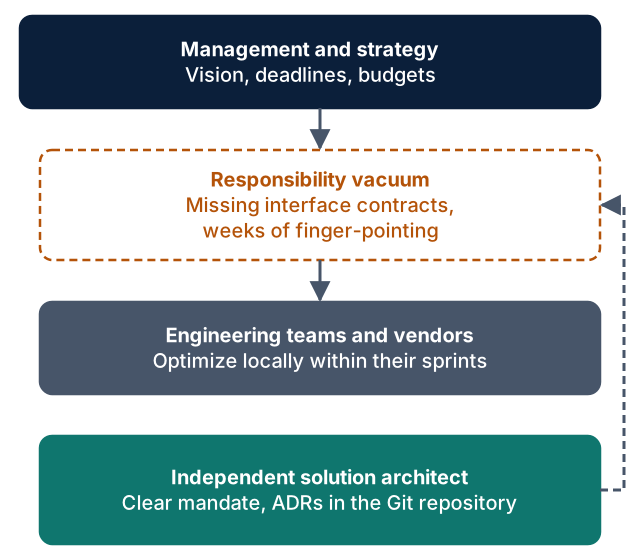
In established enterprise environments, two distinct organizational worlds frequently collide with mismatched expectations and detail levels:
- Strategy and Executive Management: Articulate ambitious transformation objectives on presentation slides. However, critical technical determinations—how authentication tokens validate across microservice boundaries, which subsystem serves as the single source of truth for master records, how asynchronous message failures are re-driven, or what monthly budget caps apply to Azure resources—remain unanswered.
- Delivery Teams and External Integrators: Develop with deep, narrow focus on their assigned feature components and sprint objectives. When an integration point breaks or cloud resource provisioning lags, the search for fault begins.
What begins as an everyday technical interface defect often degenerates into weeks of friction, blame-shifting, and project inertia between competing suppliers.
The chasm in between is a classic responsibility vacuum: nobody in the project possesses simultaneously the contractual mandate, the architectural helicopter view, and the hands-on engineering authority to define and enforce system boundaries, data contracts and quality standards across all participating parties.
What a Solution Architect Actually Owns
The curriculum of the International Software Architecture Qualification Board (iSAQB) for the Certified Professional for Software Architecture (CPSA) defines the essence of architecture work with precision. Software architecture is not about sketching abstract diagrams; it entails four decisive technical leadership responsibilities:
- Clarify and Enforce Quality Attributes: Maintainability, reliability, latency thresholds and operability. The international standard ISO/IEC 25010 provides the formal taxonomy to translate vague stakeholder aspirations into objectively testable criteria. Sources: iSAQB Curricula and ISO/IEC 25010, retrieved 21 November 2026.
- Define System and Interface Boundaries: Establish modular decoupling, communication paradigms (synchronous REST/gRPC vs. asynchronous event-driven messaging via Azure Service Bus), and strict contract schemas.
- Decide and Document Irreversible Choices: Methodically evaluate, justify and record architectural trade-offs that, if incorrectly chosen, would incur six-figure remediation costs down the road.
- Govern Technical Risk: Serve as the authoritative translator and mediator between executive management, operational business departments, internal developers and infrastructure teams.
Anonymized Case Illustration: Two external IT service providers worked in parallel on an integrated logistics and billing platform. Because the initial specifications failed to assign authoritative master data ownership for customer and address entities, both supplier teams constructed separate database schemas with conflicting validation rules. After several months in production, thousands of customer records had drifted out of sync.
Resolving this deadlock had nothing to do with coding speed; it required an architectural governance decision: establishing the authoritative system of record, placing an Anti-Corruption Layer in between, and formally specifying the asynchronous event sequence.
Comparative Analysis: Body Leasing, Systems Integrators, or Independent Architect?
When architectural needs arise, enterprises frequently default to existing framework agreements. It is instructive to examine the commercial incentives underlying each model:
| Operating Model | Core Strengths | Operational Limitations in Projects |
|---|---|---|
| Body Leasing<br>(Developers contracted on time & materials) | Immediate delivery throughput for well-defined backlog items. | Individual contractors work on assigned tickets. They lack the mandate, seniority, and organizational independence to enforce cross-vendor architecture standards. |
| Systems Integrator<br>(Large IT consulting firms) | Extensive bench capacity, established delivery teams, broad technology portfolio. | Recommendations may be influenced by commercial partnerships, software resale margins, or the need to maximize utilization of large internal staffing pools. |
| Independent Solution Architect<br>(Retained on an assessment or advisory mandate) | 100% objective alignment with client interests. Zero vendor resale bias. End-to-end technical leadership through final acceptance. | Does not provide large scale staffing armies; collaborates closely and demanding with existing internal teams and vendor partners. |
An independent solution architect stands exclusively in the client's corner. The objective is not to maximize billable consulting hours, but to architect the leanest, lowest-maintenance, and most cost-effective technical solution that reliably achieves the business goal.
Documenting Decisions in Git: Architecture Decision Records (ADRs)
Verbal agreements reached in meetings and decisions buried in static document files are consistently forgotten within months. When key project personnel rotate, the exact same fundamental arguments are rehashed from scratch.
The Microsoft Azure Well-Architected Framework therefore recommends maintaining architectural choices as versioned Architecture Decision Records (ADRs) directly inside the application's Git repository. Source: Microsoft Learn, Maintain an architecture decision record, retrieved 21 November 2026.
- An effective, lightweight ADR template features five structured components:
- Title & Status: Unique sequential identifier with lifecycle state (
proposed,accepted,superseded). - Context: What concrete technical friction or business constraint necessitates a decision?
- Considered Alternatives: Which two to three options were evaluated (e.g. Azure Functions vs. Azure Container Apps)?
- Decision: Which architecture was selected, and what rationale drove the choice?
- Consequences: What operational advantages are gained, and which technical trade-offs or constraints are consciously accepted?
Because ADRs reside in the same repository as the application code (e.g. in docs/adr/), they are immediately discoverable for every engineer, fully versioned, and reviewed via pull requests under the four-eyes principle just like production code.
The Triad of Technical Excellence: Architecture, Requirements, Quality
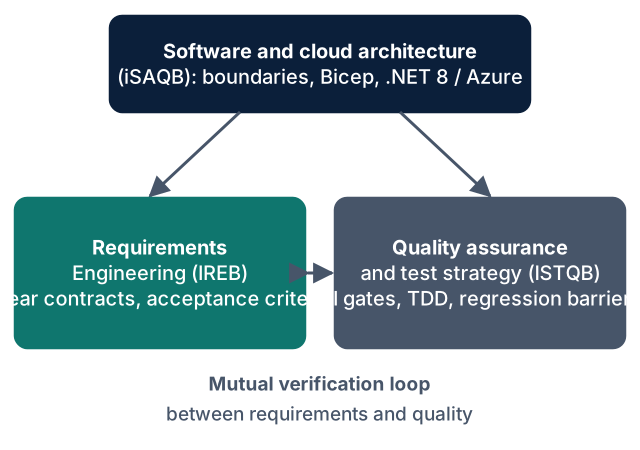
Technical leadership achieves maximum impact when three professional disciplines operate in harmony:
                            +--------------------------+
                            | Software & Cloud         |
                            | Architecture (iSAQB)     |
                            +------------+-------------+
                                         |
                                         | Modular boundaries,
                                         | Bicep IaC, .NET 8 / Azure
                                         |
              +--------------------------+--------------------------+
              |                                                     |
              v                                                     v
+--------------------------+                               +--------------------------+
| Requirements             |                               | Quality Assurance &      |
| Engineering (IREB)       | <===========================> | Test Strategy (ISTQB)    |
+--------------------------+   Mutual Verification Loop    +--------------------------+
| Unambiguous contracts,   |                               | Automated CI gates,      |
| clear acceptance criteria|                               | TDD, regression barriers |
+--------------------------+ +--------------------------+- Software and Cloud Architecture (iSAQB Foundation): Clean domain decomposition, robust target architectures for .NET and Azure, and consistent automation via Infrastructure as Code (Bicep). To understand how to structure lean cloud infrastructure without hidden cost traps, explore our guide Low-Cost Enterprise Azure Architecture with Bicep.
- Requirements Engineering (IREB Foundation): Precise functional and non-functional specifications, well-defined scope boundaries, and unambiguous interface contracts. The vast majority of supplier disputes originate from ambiguous specifications rather than poor code.
- Quality Assurance & Test Strategy (ISTQB Foundation): Upfront acceptance criteria, automated CI/CD pipeline verification gates, and systematic regression protection from day one.
Architecture conceived without verifiable requirements and automated testability remains theoretical. Only when all three pillars unite does software delivery become predictable and verifiable.
The Starting Point: A Structured Architecture Assessment
Prior to committing major capital to new software initiatives or when rescuing troubled legacy modernizations, initiating work with a structured Architecture Assessment provides immediate clarity.
- An independent IT project analysis identifies within days:
- Where critical architectural risks and single points of failure exist.
- Which Azure resources generate disproportionate operational expenditure.
- Which interface contracts between suppliers remain ambiguous.
- Which legacy components obstruct agile delivery. (For deeper insights on this topic, see Replacing Legacy Without a Big Bang).
The deliverable is not an unreadable 200-page academic report, but a prioritized roadmap ranked by business impact, urgency, and engineering effort. This assessment requires zero invasive access to production databases, does not interrupt ongoing operations, and provides executive leadership with immediate clarity for strategic decisions.
Frequently Asked Questions (FAQ)
### Cannot our senior developers handle software architecture alongside their sprint tasks? Senior developers are indispensable for ensuring high code quality. In daily operations, however, their focus is dedicated to delivering sprint backlog items. They rarely have the time or the formal mandate to negotiate contracts across multiple vendor boundaries, align cross-departmental stakeholders, or enforce corporate security and cost guardrails against resistance. A solution architect establishes the stable framework within which developers can code undisturbed.
### Does formal architecture governance slow down agile delivery cycles? Only when architecture is practiced as a bureaucratic ivory tower with months of upfront waterfall documentation. A modern solution architect operates hands-on close to the code, relying on lightweight mechanics: concise ADRs in Git repositories, clear interface contracts, and automated quality gates in the pipeline. This measurably accelerates engineering velocity by preventing fundamental questions from being debated repeatedly.
### How does an independent architect collaborate with our existing IT service providers? An independent architect does not work against existing IT vendors, but partners with them collaboratively. The architect relieves suppliers of ambiguity by supplying precise interface contracts, explicit acceptance criteria, and definitive architectural decisions. This reduces coordination friction and shields both parties from expensive rework.
### What technological platforms are emphasized in your architecture advisory? Our advisory centers on modern enterprise applications within the Microsoft ecosystem: modern .NET architectures (.NET 8+), Azure cloud platforms, microservices, event-driven architectures, and the incremental migration of legacy systems (such as ColdFusion, Classic ASP, or .NET Web Forms).
Next Steps
Are you preparing a complex IT initiative or seeking an independent review of your existing .NET and Azure architecture?
- Learn more about retaining independent technical leadership under Azure Solution Architect.
- If you need immediate visibility into risks, dependencies, and action items across your IT landscape, begin with an IT Project Analysis.
- Sources (retrieved 21 November 2026):
- iSAQB (International Software Architecture Qualification Board), CPSA Curricula:
https://www.isaqb.org/certifications/curricula/ - ISO/IEC 25010 Systems and software engineering — Systems and software Quality Requirements and Evaluation (SQuaRE):
https://www.iso.org/standard/35733.html - Microsoft Learn, Maintain an architecture decision record:
https://learn.microsoft.com/en-us/azure/well-architected/architect-role/architecture-decision-record - Fuerpass Solutions, Roles and Technical Responsibilities:
docs/03_team_and_responsibility.md