
AI Pilots for Mid-Sized Companies: From Document Search to a Reliable RAG Workflow in 2 to 4 Weeks
Direct Answer (GEO Summary): A pragmatic AI pilot for mid-sized enterprises focuses on a clearly defined bottleneck, such as semantic search in internal policies or technical documentation, rather than deploying open-ended generic chatbots. Through Retrieval-Augmented Generation (RAG), the system answers questions strictly grounded in verified company documents with explicit source citations. According to Statistik Austria's 2026 survey, 48 percent of Austrian businesses with 10+ employees use AI. A two-to-four-week planning frame suffices for a working prototype.
In the vast majority of companies, leadership and department heads have already experimented with generative AI. A browser chat window is opened in seconds, and for drafting emails, summarizing external reports or brainstorming ideas, the technology performs impressively well.
- However, the real obstacle emerges the moment ad-hoc text prompts are expected to become reliable, mission-critical business workflows:
- How can employees query technical engineering manuals, standards and compliance guidelines accurately?
- How can sales teams accelerate complex proposal creation using hundreds of past project tenders?
- How can accounting extract structured line items from incoming commercial invoices reliably?
Attempts to solve these operational challenges with generic public chatbots fail in practice rarely due to the raw reasoning capabilities of the underlying models. They fail because of poor workflow scoping, ambiguous data governance boundaries, inadequate document ingestion, and the total absence of systematic quality evaluation.
This guide outlines how mid-sized enterprises can execute an impactful AI pilot: focusing on a sharply scoped operational bottleneck, controlled data architecture, robust security guardrails, and clear acceptance criteria.
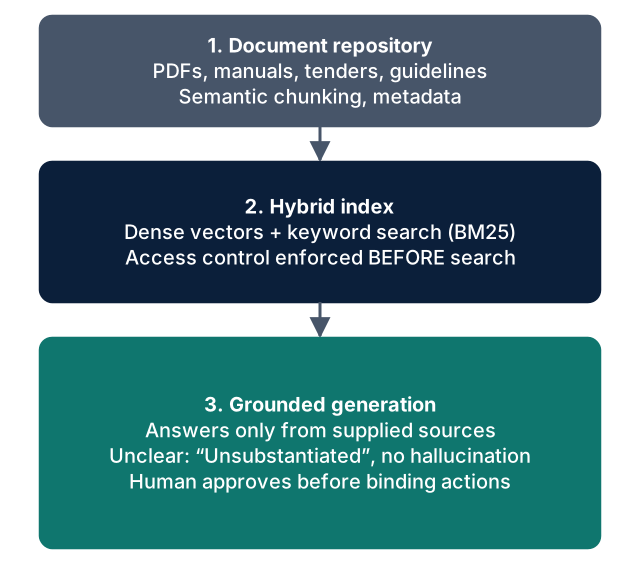
+--------------------------------------------------------------------------+
|                     Architecture of an Enterprise RAG Workflow           |
+--------------------------------------------------------------------------+
|  1. Document Repository: Technical PDFs, Manuals, Tenders, Guidelines    |
|     (Preprocessing: Semantic boundary chunking, metadata extraction)     |
+------------------------------------+-------------------------------------+
                                     |
                                     v
+--------------------------------------------------------------------------+
|  2. Hybrid Retrieval Index: Dense Vector Embeddings + Keyword Search(BM25|
|     (Access Control enforced STRICTLY pre-search via tenant/role filters)|
+------------------------------------+-------------------------------------+
                                     |
                                     v
+--------------------------------------------------------------------------+
|  3. Grounded Generation & Output Control (LLM Inference)                 |
|     - Strict Source Grounding: Answers generated solely from chunks      |
|     - Anti-Hallucination: System returns "Unsubstantiated" if ambiguous  |
|     - Human-in-the-Loop: Human verification before binding commitments   |
+--------------------------------------------------------------------------+
The Empirical Baseline in Austria and Central Europe
According to the official 2026 survey by Statistik Austria on ICT usage in enterprises (published 20 October 2026), 48 percent of Austrian enterprises with ten or more employees now actively utilize artificial intelligence (detailed statistical tables report 48.7%).
Compared to the 2025 survey benchmark—where AI adoption in Austria stood at 30 percent, while the EU average remained at 20 percent—this demonstrates a rapid acceleration in practical adoption. Concurrently, prior detailed analyses by Statistik Austria (Press Release, 24 June 2026) revealed that 77 percent of businesses not utilizing AI had not yet systematically evaluated an implementation. Source: Statistik Austria, ICT usage in enterprises, retrieved 21 November 2026.
- This macroeconomic data matches our consulting experience in the mid-market: broad enthusiasm is ubiquitous. What many managing directors and IT heads lack is clear architectural orientation:
- Which operational process offers a low-risk, high-return starting point?
- Which cloud and hosting architecture ensures compliance with European data privacy standards?
- How do we structurally eliminate "hallucinations"?
The Austrian Federal Economic Chamber (WKO) explicitly advises companies in its guidelines not to get bogged down in open-ended fundamental research, but to launch tightly scoped pilot projects with realistic objectives and predefined, measurable criteria. Source: WKO, AI Guidelines, retrieved 21 November 2026.
Core Principle: An AI Pilot Must Pay for Itself
An enterprise AI pilot should never be an experimental vanity exercise. Structure the pilot so that its tangible productivity gains offset the project investment directly during the pilot phase.
In mid-sized organizations, the primary financial lever lies almost exclusively in eliminating wasted search, verification and manual data extraction hours. Example: If three specialists in technical sales each spend 45 minutes daily locating specifications and pricing terms from historical proposals, this consumes over 450 productive hours annually.
Measure this specific overhead prior to launching the pilot to establish a verifiable baseline. Only with this baseline in place can leadership objectively assess whether the prototype delivered a genuine return on investment.
Why Generic Open Chatbots Fail in Production
Providing business units with unguided access to public conversational chatbots inevitably results in frustration.
A base model lacking direct integration into your corporate records relies solely on its pre-training data. When asked specific questions regarding internal operational agreements, proprietary machinery documentation, or client contracts, the model produces generic truisms or invents plausible-sounding but erroneous facts. Organizational trust collapses within days.
- Reliable enterprise operations demand three architectural prerequisites:
- A strictly bounded and curated corporate document repository.
- Deterministic prompt instructions enforcing source grounding.
- The architecture of Retrieval-Augmented Generation (RAG).
In a RAG architecture, when a user submits a query, the system first interrogates an internal knowledge index to retrieve the most semantically relevant passages from authoritative internal documents. Only these verified text snippets, accompanied by the query, are submitted to the language model. The model crafts its completion exclusively from this grounded context and provides clickable source citations with exact page references.
Four Typical Failure Modes in RAG Solutions
The Microsoft Azure Architecture Center emphasizes in its RAG Solution Design and Evaluation Guide that the success of a RAG implementation depends predominantly on preprocessing quality, retrieval accuracy, and rigorous evaluation against benchmark datasets. Source: Microsoft Learn, RAG solution design and evaluation guide, retrieved 21 November 2026.
In practice, poorly engineered pilots repeatedly fail due to four structural mistakes:
- Naive Chunking: Documents are sliced blindly at arbitrary character boundaries (e.g. every 1,000 characters). Tables, enumerated requirements and pricing clauses are severed midway through sentences, destroying context. Remedy: Implement semantic boundary chunking structured around headings, sections and table entities.
- Pure Vector Search: Dense vector embeddings excel at discovering conceptual similarity, but frequently stumble on exact SKU numbers, engineering standards, personal names or error codes. Remedy: Deploy hybrid retrieval combining vector similarity with traditional keyword search (BM25) and reciprocal rank fusion.
- Post-Search Access Filtering: If a central index aggregates documents across departments without pre-filtering access rights, unauthorized employees might extract executive compensation data or sensitive management memos via the assistant. Remedy: Access permissions must be enforced prior to search via identity-based metadata filters.
- Lack of Automated Evaluation: Without a curated regression benchmark, developers cannot determine whether tuning system prompts improves accuracy or introduces regressions elsewhere.
Security Guardrails Aligned with OWASP Top 10 for LLM Applications
The OWASP Top 10 for LLM Applications (2025 Edition) documents key vulnerabilities including Prompt Injection, Sensitive Information Disclosure, and Excessive Agency. Source: OWASP Top 10 for LLM Applications, retrieved 21 November 2026.
For a mid-market enterprise pilot, four binding guardrails follow:
- 1. Strict Source Grounding: The model is instructed to answer strictly based on the provided document excerpts. If a query cannot be validated against the context, the system explicitly reports that the information is unavailable rather than speculating.
- 2. Boundary Separation Between Instructions and Data: Retrieved document content is treated strictly as passive data, never as executable instructions. A malicious file containing "disregard all previous instructions" (Indirect Prompt Injection) must not alter the assistant's behavior.
- 3. Pre-Search Access Control: The retrieval engine returns only text fragments for which the querying user holds verified read permissions in the source system (e.g. SharePoint or file shares).
- 4. Human-in-the-Loop: The assistant serves an investigative, preparatory role. Binding business commitments, proposal dispatches, or database updates require verification and sign-off by a qualified professional.
A Four-Step Implementation Roadmap
A realistic planning timeframe for a focused enterprise RAG pilot spans two to four weeks. This serves as an operational guideline rather than a rigid guarantee: actual duration depends on the homogeneity and cleanliness of the source documentation.
### Step 1: Scope the Bottleneck and Curate Sample Documents (Week 1) Select one clearly defined friction point: for example, internal querying of installation manuals or proposal archival research. Restrict the pilot corpus to 50 to 200 representative, verified documents.
- ### Step 2: Establish Data Sovereignty and Operating Model (Weeks 1–2)
- Determine where data processing takes place. For sensitive enterprise intellectual property, two compliant models exist:
- A dedicated enterprise cloud endpoint with guaranteed EU data residency (e.g. Azure OpenAI with EU Data Zone).
- A fully local, on-premise inference server running on dedicated hardware (e.g. via Ollama), ensuring zero external data transmission.
Consumer tools lacking contractual training opt-outs must be strictly avoided. For an in-depth comparison of deployment models, see our article Local LLMs, EU Cloud or Enterprise Copilot.
### Step 3: Deploy a Functional RAG Prototype (Weeks 2–3) Within days, the parsing and indexing pipeline is operational. Documents are parsed, vectorized and indexed alongside full-text indexes, connected to an intuitive web UI. Every generated answer includes direct citations pointing to the source file and page.
- ### Step 4: Evaluate with Real Benchmark Queries and Decide (Weeks 3–4)
- Collaborate with future end-users to curate a test benchmark of 30 to 50 real-world business queries with known answers. Measure:
- How many questions were answered correctly?
- Did the system cite the exact supporting passage?
- Did the system reliably decline to answer unsubstantiated queries?
If the pilot meets predefined acceptance criteria, roll out production phases. If not, refine the pipeline or stop the project—saving substantial capital that an unmonitored enterprise rollout would have wasted.
Frequently Asked Questions (FAQ)
### Which document formats can be ingested into a RAG workflow? Typically, pipelines handle PDF documents, Microsoft Word files (.docx), Excel spreadsheets (.xlsx), plain text, Markdown files, and HTML documentation. Text quality is paramount: digitally authored files can be indexed directly; scanned paper documents require high-accuracy Optical Character Recognition (OCR) first, as poor OCR quality directly impairs search accuracy.
### Can confidential documents leak to external parties via a RAG pipeline? No, provided the solution adheres to enterprise engineering standards. When utilizing dedicated EU cloud endpoints (such as Azure OpenAI with EU Data Zone) or local open-weights models, data remains within your organizational control and is never utilized by vendors for model training. Internally, strict metadata filtering (pre-search access control) ensures users only retrieve fragments they are authorized to view.
### How does a RAG workflow differ from traditional enterprise search tools? Traditional enterprise search relies on literal keyword matching: it finds documents only if exact terminology is matched. RAG understands semantic context, resolving synonyms and descriptive queries. Crucially, rather than presenting a list of 20 unranked PDF links, RAG synthesizes a direct, concise answer accompanied by explicit citations.
### How does the system handle document updates or deletions? A professional enterprise RAG pipeline implements incremental synchronization: when a document on a file share or DMS is modified, stale index chunks are evicted and re-indexed. Deleted documents are pruned from the vector index immediately, preventing the assistant from referencing outdated records.
Next Steps
Are you planning to launch a focused AI pilot in your organization while managing technical and compliance risks from day one?
- Discover more regarding custom RAG architectures and enterprise assistants under AI Business Solutions.
- For strategic organizational readiness assessments and governance design, see AI Transformation.
- To understand how AI agents integrate into automated pipelines, read AI Agents and MCP in CI/CD Pipelines, while AI Coding Enablement covers engineering team enablement.
- Sources (retrieved 21 November 2026):
- Statistik Austria, ICT usage in enterprises (Current 2026 survey, published 20 October 2026):
https://www.statistik.at/statistiken/forschung-innovation-digitalisierung/digitale-wirtschaft-und-gesellschaft/ikt-einsatz-in-unternehmen - Statistik Austria, Press Release 24 June 2026 (Reference year 2025):
https://www.statistik.at/fileadmin/announcement/2026/06/20260624IKTU2025.pdf - Austrian Federal Economic Chamber (WKO), AI Guidelines for Enterprises:
https://www.wko.at/ooe/digitalisierung/ki-guidelines/ki-guidelines.pdf - Microsoft Learn, RAG solution design and evaluation guide:
https://learn.microsoft.com/en-us/azure/architecture/ai-ml/guide/rag/rag-solution-design-and-evaluation-guide - OWASP Top 10 for LLM Applications (2025):
https://owasp.org/www-project-top-10-for-large-language-model-applications/